From Battery Ownership to Battery Lifecycle: Building a Circular Economy for Electric Vehicles


GoPlug Smart
October 21, 2026
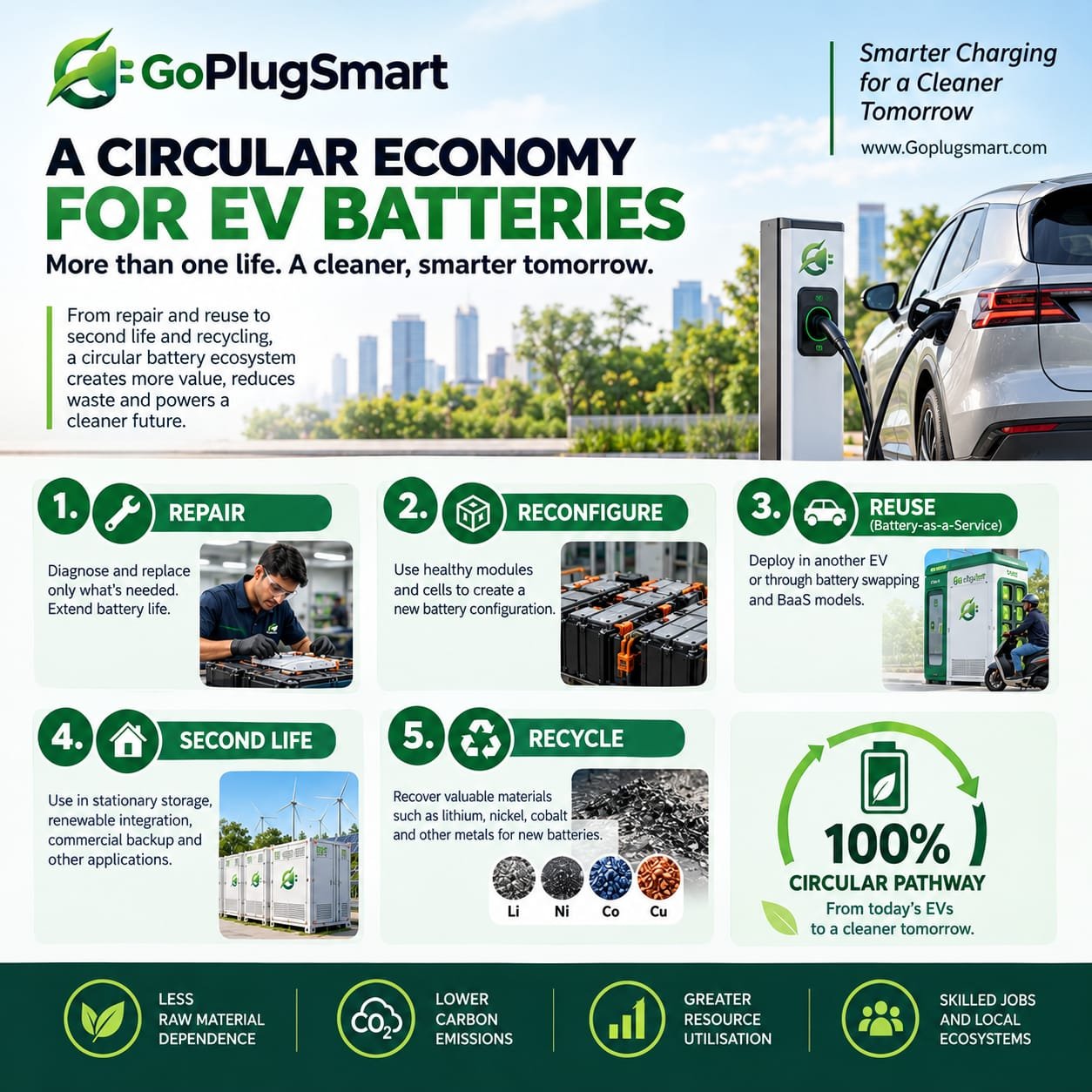
Electric mobility is often described as a cleaner alternative to conventional transportation. But the real sustainability of an electric vehicle does not end when the vehicle leaves the showroom. It depends on what happens to the battery during its entire life — from installation and repair to replacement, reuse, second-life applications and, finally, material recovery.
This is where the circular economy for EV batteries becomes important. The idea is simple: a battery should not be treated as a disposable component. It should be treated as an asset that can deliver value through multiple stages of its life.
A battery that is no longer suitable for one vehicle may still be perfectly useful in another vehicle, a different configuration, a battery-swapping network, a stationary energy-storage system or, at the end of its useful life, as a source of recoverable materials.
The opportunity is becoming significant. The IEA estimates that global electric-car sales exceeded 20 million in 2025, representing around one in four new cars sold worldwide. At the same time, EV battery deployment reached approximately 1.2 TWh in 2025, nearly 30% higher than in 2024. IEA
That scale changes the question. The question is no longer simply how many EVs can we sell? It is also: How do we keep the battery useful for as long as possible and recover its value when it can no longer serve its original purpose?
The Battery Should Have More Than One Life – A conventional approach to an EV battery is straightforward:
Manufacture → Install → Use → Battery failure → Replace → Recycle
A circular model is different:
Manufacture → First-life vehicle → Diagnosis → Repair / Reconfiguration → Reinstallation / BaaS → Second-life use → Component recovery → Material recycling →
New battery
The distinction is important. A battery can have a problem without actually being at the end of its life. A failed module, faulty sensor, contactor, cooling component, wiring harness or battery-management-system issue can sometimes make an otherwise useful battery appear to be “dead.” Replacing the entire pack in such a situation can unnecessarily increase cost and waste.
The BCG study provided with this article makes the same distinction between recycling and second-life use. It explains that batteries leaving their first automotive life can go into recycling, second-life applications or disposal, and highlights the value of grading and repurposing batteries before material recovery. The Case for a Circular Economy
The opportunity is therefore not simply battery recycling. It is battery lifecycle management.
One of the biggest opportunities in EV circularity is to move away from the traditional “replace the complete battery” approach. A modern EV battery pack contains multiple components:
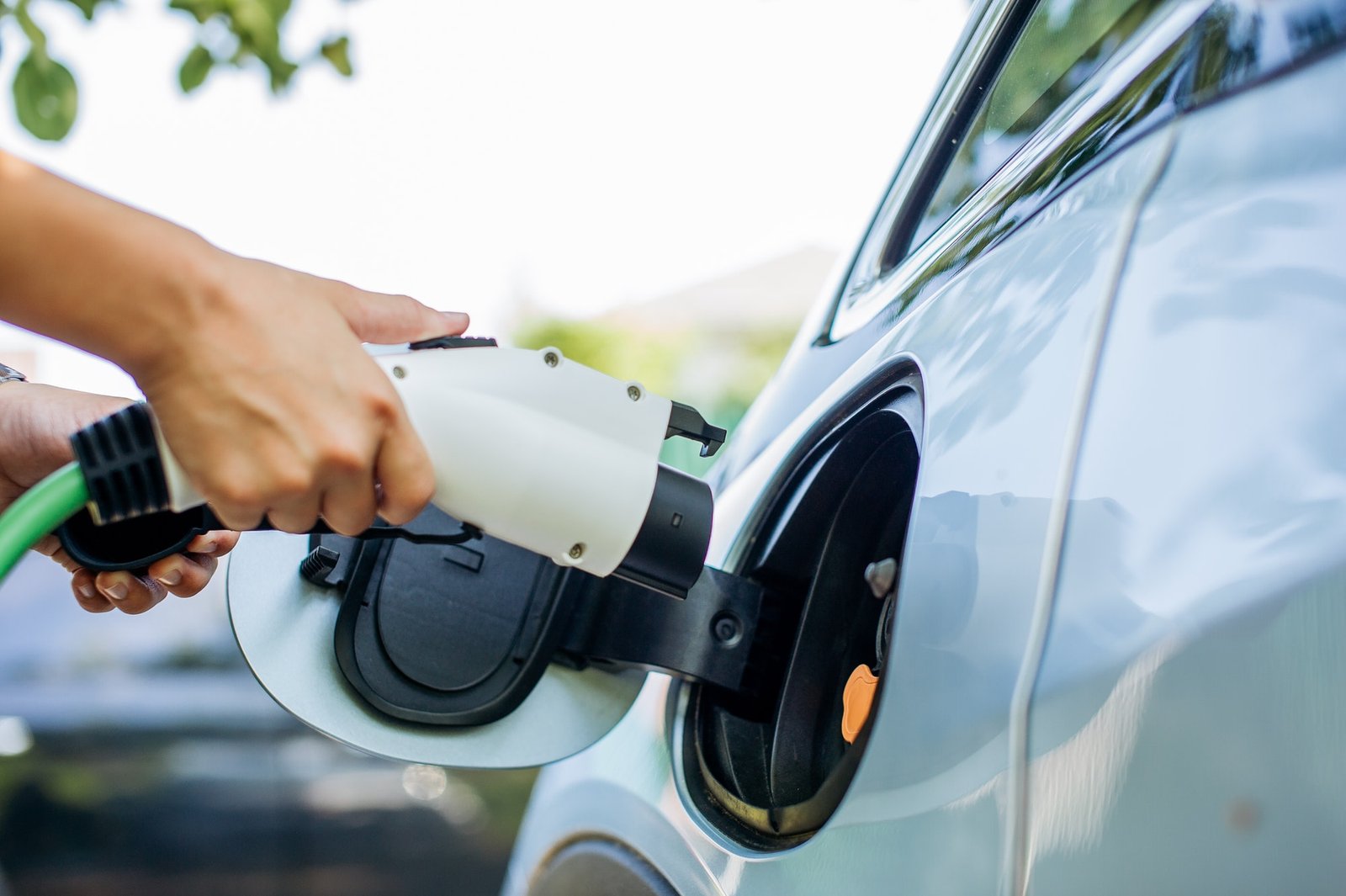
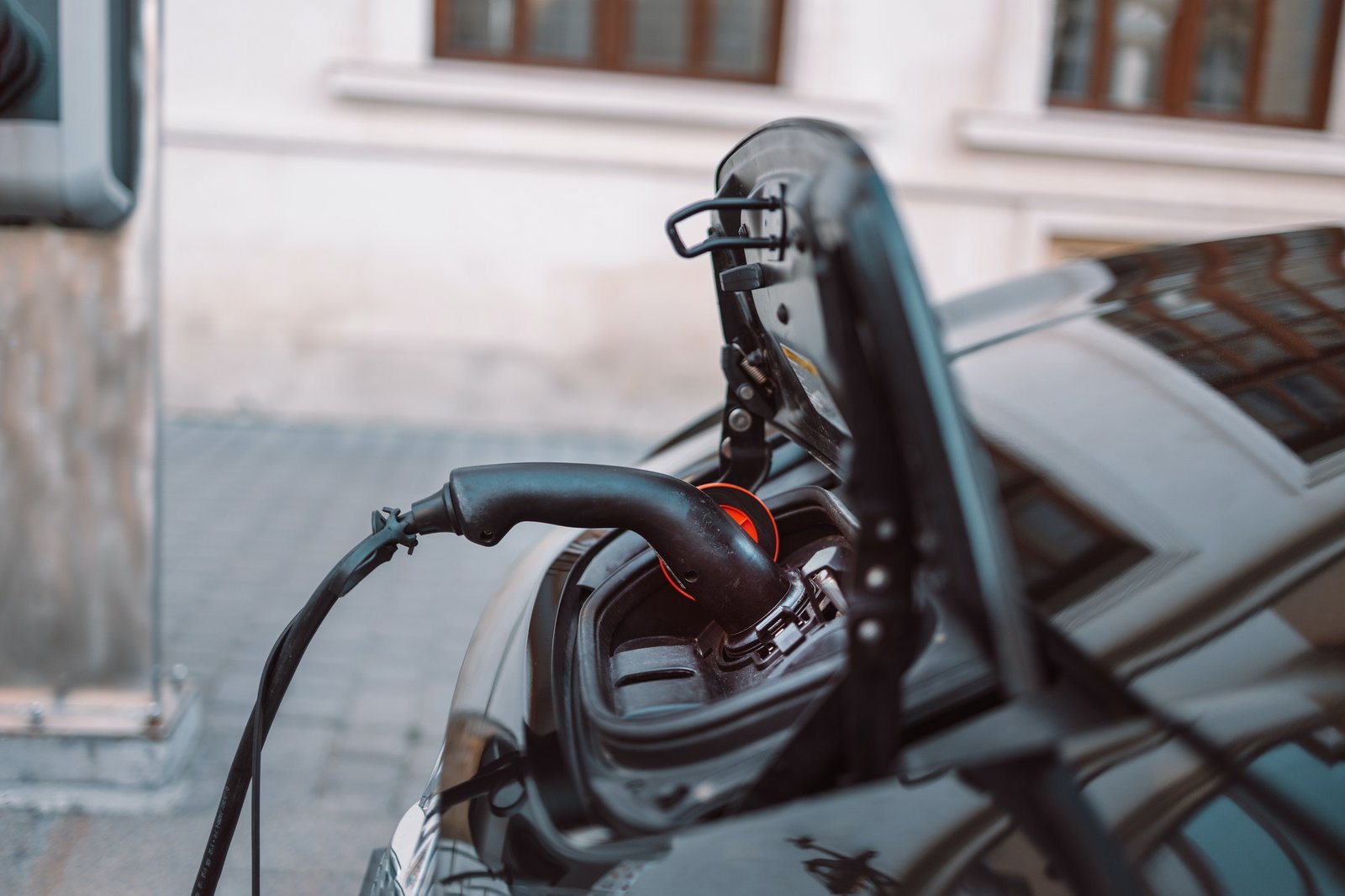
If one component fails, the entire battery does not necessarily need to become waste.
A proper battery health assessment can determine:
If the problem is localized, the appropriate solution may be module replacement, component repair, BMS repair/recalibration, connector replacement, thermal-system repair or electrical reconfiguration. This extends the first life of the battery without introducing a new battery into the vehicle.
The principle is straightforward:
Repair the smallest failed component instead of replacing the largest possible component. This is one of the simplest ways to reduce both cost and material consumption.
Not every battery pack needs to return to the same vehicle configuration. This creates another important opportunity: battery reconfiguration.
Suppose a battery pack was originally designed for a particular vehicle with a certain power requirement. After years of use, some modules may have degraded more than others.
Instead of discarding the complete pack, the pack can be:
The result is effectively a new operating configuration from an existing battery asset.
This approach becomes particularly interesting for commercial EVs, three-wheelers, fleet vehicles and battery-swapping ecosystems where battery utilisation is high and downtime directly affects earnings.
Battery-as-a-Service, or BaaS, takes circularity one step further.
Instead of the customer buying the battery as part of the vehicle, the battery can be provided as a service.
The concept separates:
Vehicle ownership from Battery ownership and management.
NITI Aayog’s draft Battery Swapping Policy described BaaS as a model that decouples the EV from the battery and allows the battery to be used as a service, including for fixed and swappable batteries. It also highlighted better lifecycle management and maximising battery utilisation as important objectives. NITI Aayog
A practical BaaS model could work like this:
Customer buys/leases EV → Battery supplied under BaaS → Battery monitored digitally → Battery serviced/repaired → Battery replaced when required → Old battery tested → Reused in another application → Recycled when no longer usable
For the customer, this can reduce the upfront cost of the vehicle.
For the battery operator, it creates a long-term asset.
For the circular economy, it creates something even more important:
ownership of the battery remains visible throughout its lifecycle.That makes collection, maintenance, refurbishment and eventual recycling much easier.
Battery swapping is often discussed mainly as a solution for reducing charging time.
There is another benefit that deserves more attention: centralised battery lifecycle management. In a swapping network, the battery can remain under the control of a battery operator. Instead of thousands of individual owners deciding what to do with old batteries, the operator can:
This creates a much more controlled circular system. It is particularly relevant for high-utilisation segments such as:
Battery degradation is often misunderstood. A battery reaching approximately 80% of its original capacity does not automatically mean that it has no value.
It may simply mean that it is no longer optimal for its original automotive application.
The BCG report used a useful example: a 60 kWh EV battery designed for 1,500 cycles could still represent substantial remaining energy capacity even after falling below the level required for vehicle use. It identified stationary storage, spare EV batteries and compact mobile storage as potential second-life applications.
The Case for a Circular Economy… Possible second-life applications include:
Solar energy storage
Used EV batteries can store electricity generated during the day and supply it later.
Commercial backup power
Battery systems can provide backup for offices, shops, warehouses and charging facilities.
EV charging infrastructure
A second-life battery can potentially be paired with charging infrastructure to reduce peak power demand.
Telecom and remote power systems
Battery storage can support backup power requirements where reliability is important.
Industrial applications
Forklifts, material-handling equipment and other stationary or low-mobility applications can potentially use appropriately tested battery systems.
The IEA also notes that EV battery reuse and repurposing remain technically and economically challenging because of safety, warranty, remaining-life uncertainty, dismantling costs and liability considerations. IEA
Therefore, second life should not mean simply taking an old battery and putting it
somewhere else. It requires testing, grading, engineering and certification.
The economics of battery circularity are evolving rapidly.
The BCG report supplied with this article estimated that the global EV battery circular economy could represent around $10 billion in revenue opportunities by 2030. At the time of the report, it also found that large-scale recycling could achieve attractive economics, while standalone second-life applications were more difficult because of testing, disassembly, integration and liability costs. The Case for a Circular Economy…
That conclusion is still relevant today, although the market has changed significantly since 2020.
The IEA reports that global battery prices continued to fall, with the average battery pack price for battery-electric cars dropping below $100/kWh in 2024. In 2025, average battery prices declined further, while LFP batteries became significantly cheaper than NMC alternatives. IEA
This creates both an opportunity and a challenge. Second-life batteries must compete with increasingly inexpensive new batteries.
Therefore, circularity businesses cannot rely only on the argument that “used batteries are cheaper.” They need to create value through:
repair + longer utilisation + lower downtime + battery-as-a-service + local deployment + material recovery.
There is an important difference between reuse and recycling.
If a battery module can safely provide another three years of useful service, recovering its lithium, nickel, cobalt or other materials immediately may not provide the maximum value.
The better sequence is:
Recover valuable materials when the battery can no longer provide safe and economical service. This is where the circular economy becomes different from simply “battery recycling.”
India’s Battery Waste Management Rules, 2022 apply to EV batteries and are based on Extended Producer Responsibility (EPR). The rules place responsibility on producers, including importers, for collection and recycling or refurbishment of waste batteries. The government has also established a centralised online EPR system for producers, recyclers and refurbishers. Press Information Bureau
The rules are particularly important because they recognise recycling and refurbishment rather than treating every used battery simply as waste.
The CPCB-published rules specify that EPR targets include the collection target and 100% recycling and/or refurbishment of the collected EPR quantity. They also define recycling to include recovery of battery materials such as lithium, nickel, cobalt, plastics, rubber and glass. Central Pollution Control Board
India has subsequently strengthened the framework. The Battery Waste Management Amendment Rules, 2025 included provisions concerning the labelling of the EPR registration number on batteries, while the government has continued developing the centralised EPR system. Ministry of Environment
As of December 2025, the Ministry of Environment, Forest and Climate Change reported approximately 4,100 registered producers and 490 recyclers on the battery-waste EPR portal. It reported around 64.37 lakh tonnes of battery waste recycled across the system and EPR certificates generated for recovered materials. Ministry of Environment
The regulatory direction is therefore clear:
The battery must remain inside a managed lifecycle rather than becoming unmanaged waste.
The phrase “100% reusable battery” needs to be used carefully. No responsible industry model should claim that every gram of every battery can currently be reused indefinitely.
Battery chemistry, degradation, contamination, safety conditions and recycling technology place practical limits on material recovery.
A more realistic target is: 100% of batteries entering a controlled circular pathway, with zero intentional disposal to landfill and maximum practical value recovery at every stage.
A future-ready model could look like this:
Stage 1 — EV Battery Production
Battery manufactured with:
↓
Stage 2 — First-Life EV
Battery operates in the vehicle.
↓
Stage 3 — Continuous Battery Health Monitoring
Data tracks:
↓
Stage 4 — Repair
If the problem is repairable:
Repair → Test → Reinstall
↓
Stage 5 — Reconfiguration
If the original configuration is no longer optimal:
Grade modules → Balance → Reconfigure → New BMS configuration → Test
↓
Stage 6 — BaaS / Battery Swapping
Battery remains under controlled ownership.
Customer pays for energy/service rather than purchasing a new battery every time.
↓
Stage 7 — Second Life
When automotive performance is no longer sufficient:
EV battery → Stationary storage / charging support / backup / industrial application
↓
Stage 8 — Material Recovery
When the battery is genuinely at the end of its useful life:
Discharge → Dismantle → Process → Recover lithium/nickel/cobalt/copper/aluminium and other materials
↓
Stage 9 — New Battery
Recovered materials return to the battery manufacturing supply chain.
Old battery → New battery
That is the real circular loop.
One of the biggest problems in battery reuse is uncertainty.A second-life operator needs to know:
What happened to this battery during its first life?
A battery that was gently operated and properly maintained is very different from one that experienced high temperatures, repeated fast charging and deep discharge.
The BCG report specifically highlighted the importance of battery history and accessible cell-level performance data for determining remaining value and reducing the cost of grading and repurposing. The Case for a Circular Economy…
A practical battery passport could contain:
This would turn a used battery from an uncertain waste product into a known-value asset.
For private passenger vehicles, battery replacement may happen after several years.
For commercial EVs, the economics are different.
An electric three-wheeler, delivery vehicle or fleet vehicle may operate for many hours every day. For such vehicles:
Battery uptime = business income.
This makes battery swapping, BaaS, repair and refurbishment particularly attractive.
Instead of waiting for a battery to completely fail, a fleet operator can exchange it, while the removed battery goes through diagnostics. If repairable:
Repair → Reinstall
If suitable for another vehicle:
Reconfigure → Deploy
If no longer suitable for mobility:
Second life → Stationary storage
If genuinely exhausted:
Recycle → Recover materials
The same battery can therefore generate value at multiple points instead of producing value only once.
Battery packs are heavy and require controlled handling.
The BCG analysis noted that transportation costs are important and discussed regional hub-and-spoke models in which smaller facilities collect and perform initial processing before sending batteries to larger recovery facilities. The Case for a Circular Economy…
India can develop similar regional battery circularity hubs.
For example:
City collection centre
↓
Battery diagnostic & repair centre
↓
Regional refurbishment centre
↓
BaaS / second-life deployment
↓
Authorised recycling facility
This approach can reduce unnecessary transportation while creating skilled employment around:
Circular economy is therefore not only an environmental opportunity.
It can become an EV services industry.
A successful circular EV company may not make its money from only selling batteries.
It can generate revenue from multiple services:
Service | Revenue Opportunity |
Battery diagnostics | Inspection fee |
Battery repair | Repair/service fee |
Module replacement | Component revenue |
Battery reconfiguration | Engineering/service fee |
Battery rental | Monthly BaaS revenue |
Battery swapping | Subscription/usage revenue |
Refurbished battery | Battery sales |
Second-life storage | Energy-storage revenue |
Battery collection | Recovery/service contracts |
Recycling | Material recovery |
Recovered materials | Sale to battery manufacturers |
Battery data | Asset valuation / lifecycle management |
This changes the economics from: “Sell one battery once” to: “Manage one battery asset for its entire useful life.”
India does not need to copy the battery ecosystem of another country.
It can build a model suited to its own market. The priorities should be:
Modular batteries should allow safe replacement of failed modules and components wherever technically feasible.
Consumers and fleet operators should have access to reliable battery health reports.
Particularly for high-utilisation two- and three-wheelers and commercial fleets.
Battery history should not disappear when ownership changes.
Refurbished batteries need safety testing, warranty and traceability.
Charging stations, solar systems, commercial backup and other energy-storage applications can provide demand.
Materials recovered from batteries should return to manufacturing rather than leaving the formal supply chain.
The industry should track: % repaired → % reconfigured → % reused → % second life → % material recovered → % disposed
The ultimate target should be to make the final number — unrecoverable disposal — as close to zero as technically possible.
The Real Meaning of a Circular EV
The success of electric mobility should not be measured only by the number of electric vehicles on the road.It should also be measured by what happens to their batteries.
The result is a very different model of mobility: Mine less → Manufacture smarter → Use longer → Repair first → Reconfigure where possible → Reuse → Repurpose → Recover materials → Manufacture again.
The global battery industry is already reaching a scale where this is no longer a future concept. The IEA estimates that around 1.2 million EV batteries could reach end of life in 2030 and about 14 million by 2040, making battery circularity an increasingly important part of the EV ecosystem. IEA
India’s Battery Waste Management Rules, EPR framework and growing EV market provide an important foundation. Press Information Bureau
The next step is to move beyond the idea of “rec ycling an old battery.”
The bigger opportunity is to keep the battery productive for as long as possible and recover its materials when productivity is no longer possible.
That is what a genuine circular EV economy should look like.
A practical 100% circularity principle
No battery should become waste simply because it has stopped being suitable for its first application.
First repair it. à Then reconfigure it. à Then reuse it. àThen repurpose it.
And only after its useful life is genuinely exhausted, recover its materials.
That is the path from EV adoption to EV sustainability.
Key reference base
(+62)81 238 1991

GoPlugSmart is a smart EV charging station locator and trip-planning solution that helps EV owners find nearby charging stations, plan efficient routes, and travel with confidence. It is designed to reduce range anxiety, GoPlugSmart makes electric journeys seamless, reliable, and sustainable.
Subscribe to our newsletter to receive updates on EV charging technology, new installations, sustainability insights, and company news.
Copyright © 2026 | GoPlugSmart
WhatsApp us
 By Logixweb